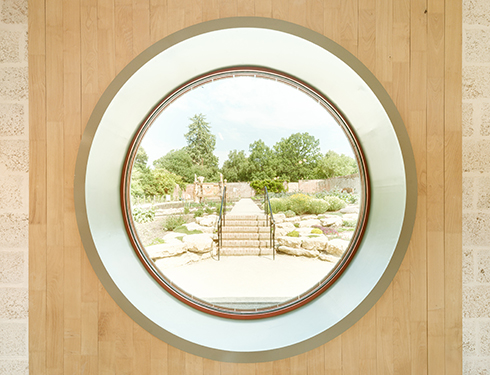
Cared for by the National Trust, Ightham Mote is a 14th-century moated manor house in Kent. Welcoming thousands of visitors each year, the site needed new facilities to replace a temporary welcome building, to improve parking and access, and to relieve pressure on its historic buildings.
The project team, led by Colvin & Moggridge, worked closely with the National Trust to meet these needs. Opened to the public in 2025, the new reception and shop, together with upgraded parking facilities that incorporate sustainable drainage, provide a permanent base for visitor facilities. Set at the edge of the reinstated walled garden, the building creates a clear point of arrival, preparing visitors for the walk down to the manor house while encouraging them to explore more of the grounds.


Siting and collaboration
The design was developed over several years with close input from the estate team, heritage advisors, and the wider consultant group. Particular attention was given to locating the building in a way that respects the historic setting, manages flooding risk, improves accessibility, and minimises archaeological impact.


Civil engineering in a sensitive setting
We supported the project with civil engineering design, including new drainage systems, access routes and parking. Sustainable drainage measures were introduced to manage run-off and reduce flood risk, designed to integrate with the historic landscape. These works improve resilience for the estate while reducing long-term maintenance demands.

A contemporary structure in a historic landscape
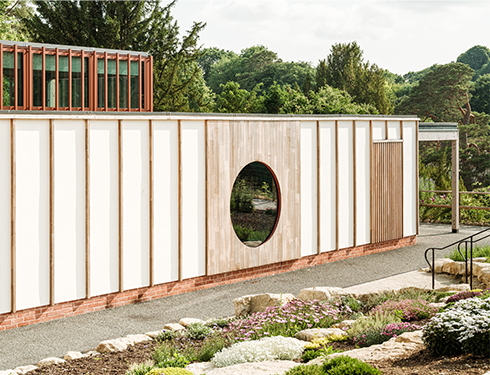
The building is contemporary in form yet draws from the historic context through its use of materials and craftsmanship. An exposed timber frame, lime render, and locally coppiced sweet chestnut are paired with 400mm-thick hempcrete block walls, supplied by The Hemp Block Company. These ultra-low carbon blocks help regulate acoustics, temperature, and humidity, reducing operational energy demand alongside the use of natural ventilation, high levels of insulation, and an air source heat pump.
Timber detailing and design
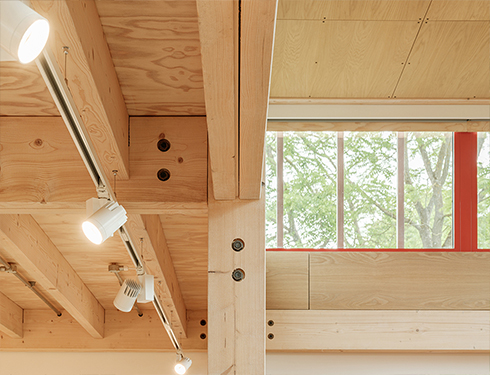
The internal timber frame was developed as a simple, low-carbon structure that exposes and celebrates wood as a natural material. The minimally processed softwood uses traditional carpentry connections – exposed roof joists half-housed into beams – with small, hidden steel flitch plates and bolts only where necessary. Larger beams and columns were designed as paired sections rather than single large timbers, an approach that minimises the risk of shrinkage and shakes appearing, but also crucially makes use of smaller, ‘lower grade’ timber sections.
We worked closely with the architect and contractor to design the notches and holes required for new service routes, ensuring these were integrated without compromising the structural performance or visual clarity of the timber frame.
Building for long-term use
The new building demonstrates how sustainable materials and modern techniques can be integrated within a sensitive historic landscape, supporting the site’s long-term stewardship.
'The smooth implementation of the project, the delivery of a sustainable modern intervention in an exceptionally delicate historic setting, has proved highly successful operationally and received plaudits from volunteers and staff as well as from the local community and visitors alike.'
Bernadette Gillow, general manager, Ightham Mote and North Kent Portfolio