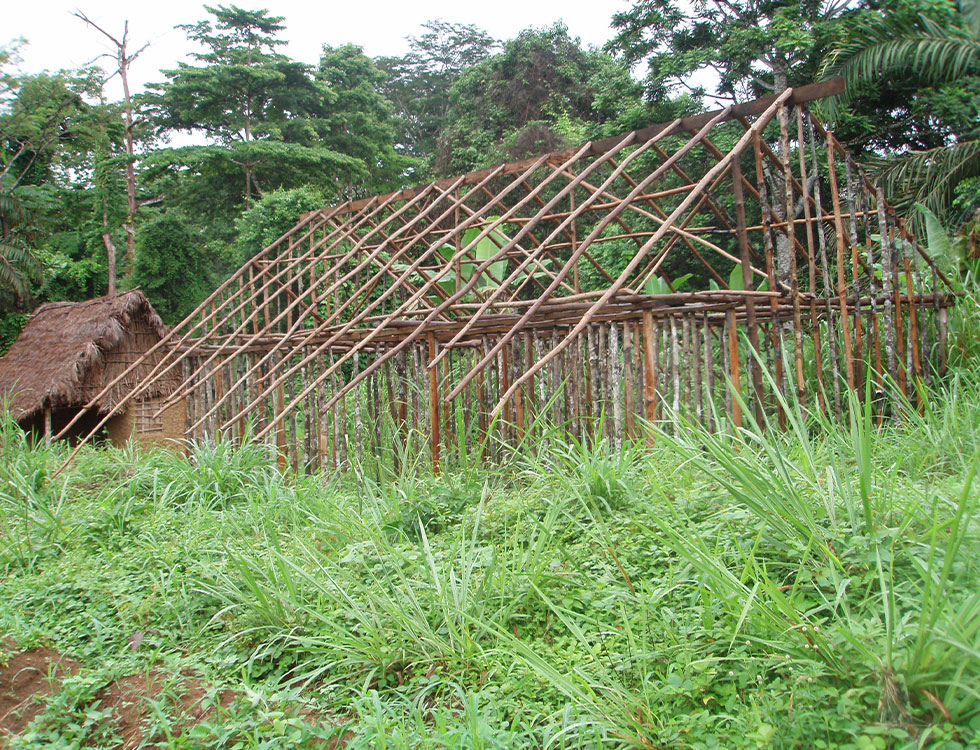
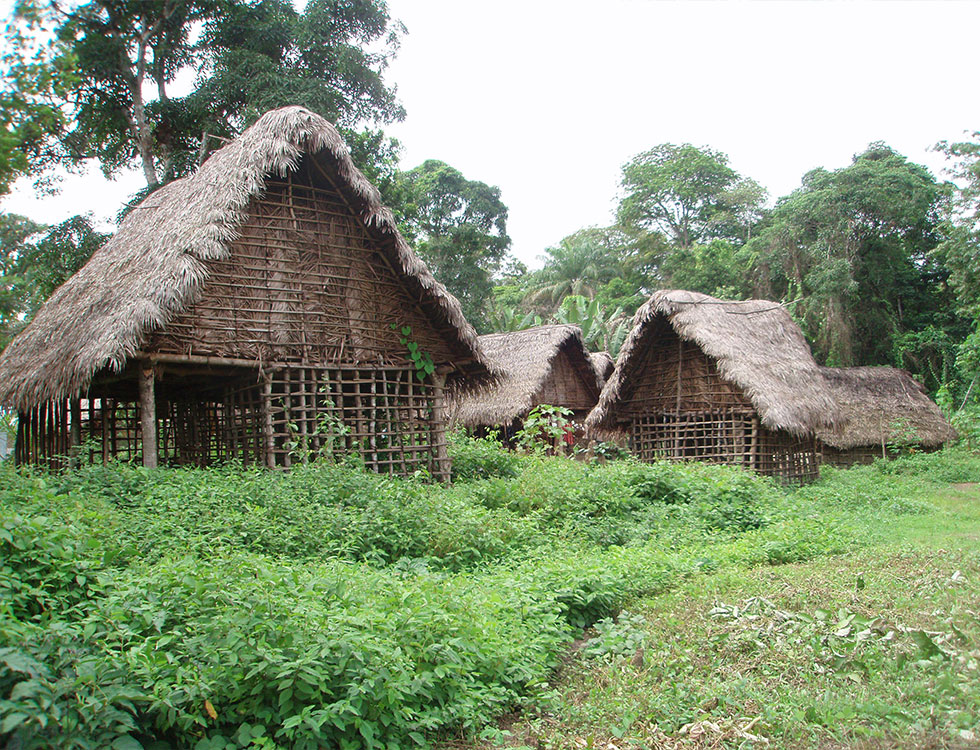
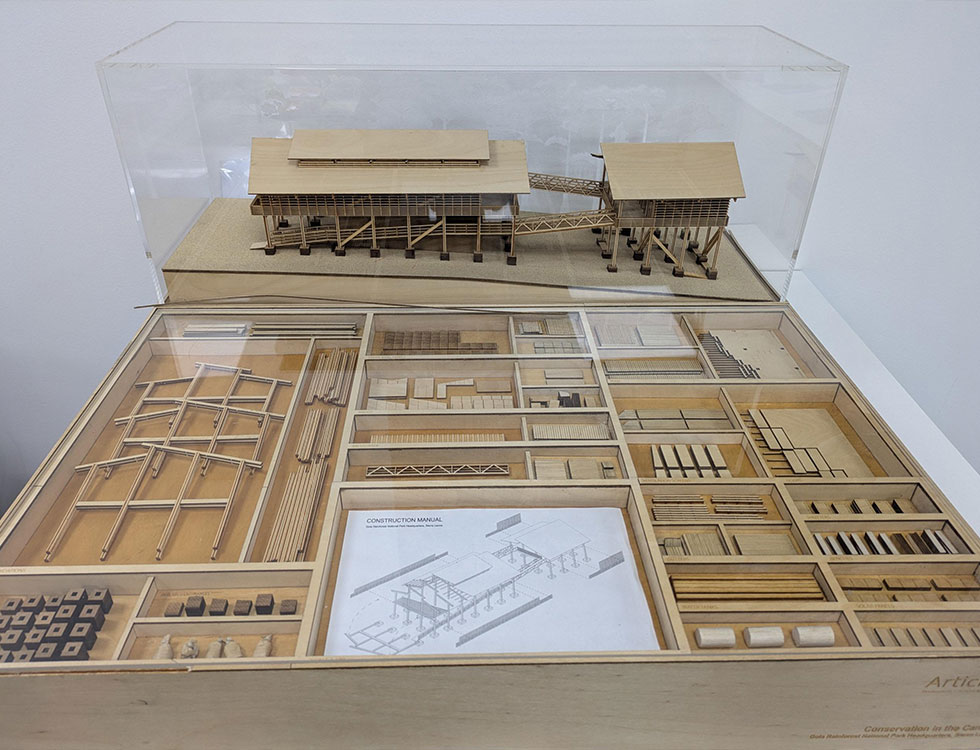
In 2009, we collaborated with Article 25, the UK’s leading architectural NGO delivering buildings for underserved communities worldwide, and the Royal Society for the Protection of Birds (RSPB) on the Gola Forest Programme Headquarters in Sierra Leone - part of an ambitious initiative to protect one of West Africa’s last remaining areas of primary rainforest. The project aimed to provide a new administrative base for the Gola Forest National Park, together with accommodation for staff and researchers, as part of a wider masterplan for sustainable community development in and around Lalehun, in the Kenema District.
Working in such a remote and environmentally sensitive location required a careful balance between technical know-how, environmental response, and practical delivery. The buildings were to be constructed within a protected forest area with limited access to materials, and a workforce with varying levels of construction experience. A big part of our role was therefore to develop a structural system that was safe, logical, and inherently buildable, with enough tolerance to accommodate manual fabrication and assembly.
A structure shaped by climate and context
The design was developed in close collaboration with Article 25’s architects. The hot, humid climate dictated much of what was possible: buildings needed to breathe, resist heavy rain, and remain cool without mechanical intervention. We therefore proposed a lightweight timber frame structure, raised on slender columns to encourage air movement under the floor and improve security. This also reduced the need for deep foundations in the wet, unstable soil conditions, while avoiding unnecessary disturbance to the ground and surrounding root systems.
The structural grid was based on a 5m x 5m module, coordinating with a 4.5m accommodation module and a 1.5m planning grid to get the efficiency and flexibility we needed across the different building types. The modular system was applied consistently - from the headquarters building to the manager’s house and visiting researcher accommodation - meaning we could make some efficiencies in repetition of detailing, minimising tooling, and simplifying training for local workers.
A braced frame system was adopted to create stability without relying on large structural members or complex joints. Horizontal bracing and diagonal ties at mid-height reduced the column sizes, good both for economy and ease of handling. The scheme was intentionally over-engineered for resilience to high humidity, movement, and the lack of formal testing or certification of local materials.
For the superstructure, we assessed a range of tropical hardwood species, including Iroko, Bilinga, Dabema, and Framire, each evaluated for strength, durability, and resistance to termites and fungi. The goal was to identify timber that could be responsibly sourced within West Africa while meeting structural and longevity requirements we would be happy with. The use of timber also dramatically reduced the embodied carbon compared with concrete, with our material studies showing a total footprint less than one-third that of a concrete equivalent.
On the ground in Lalehun
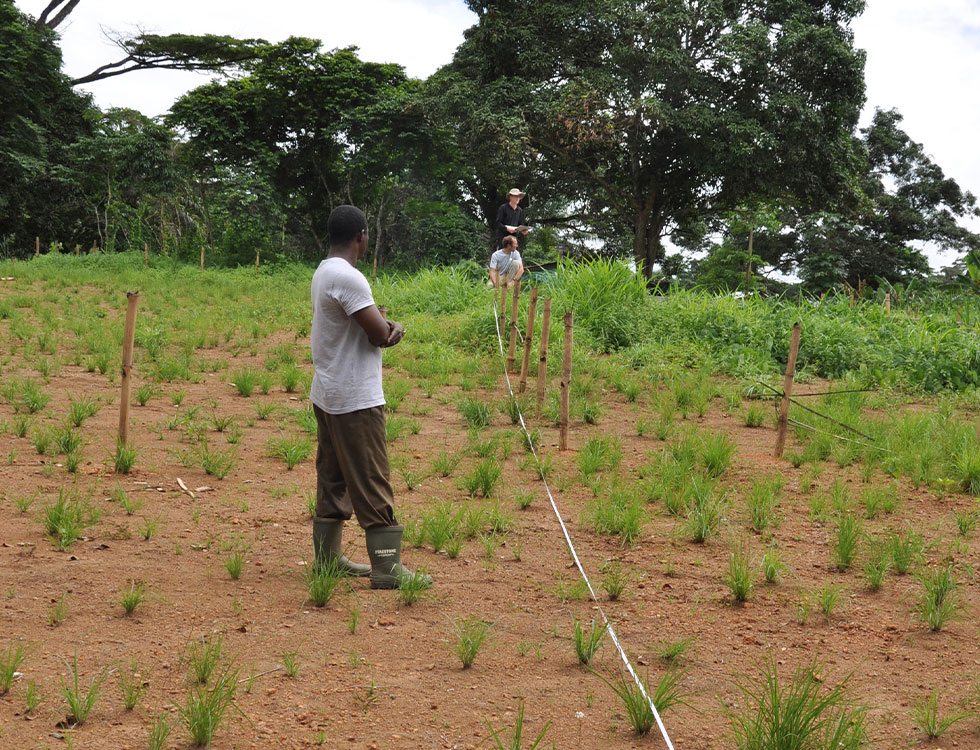
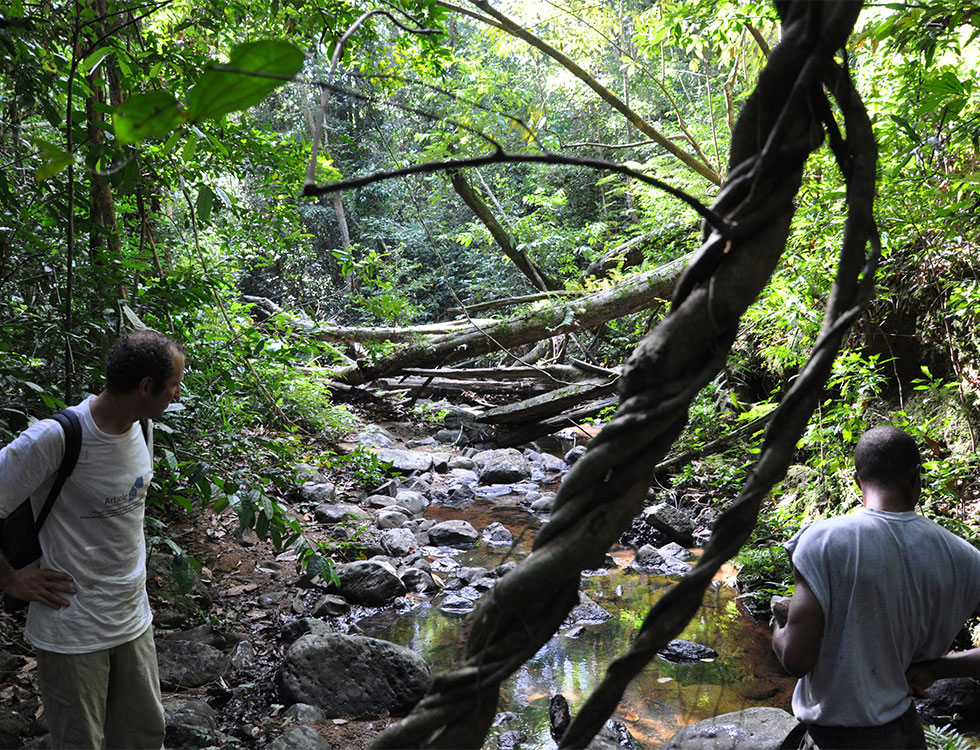
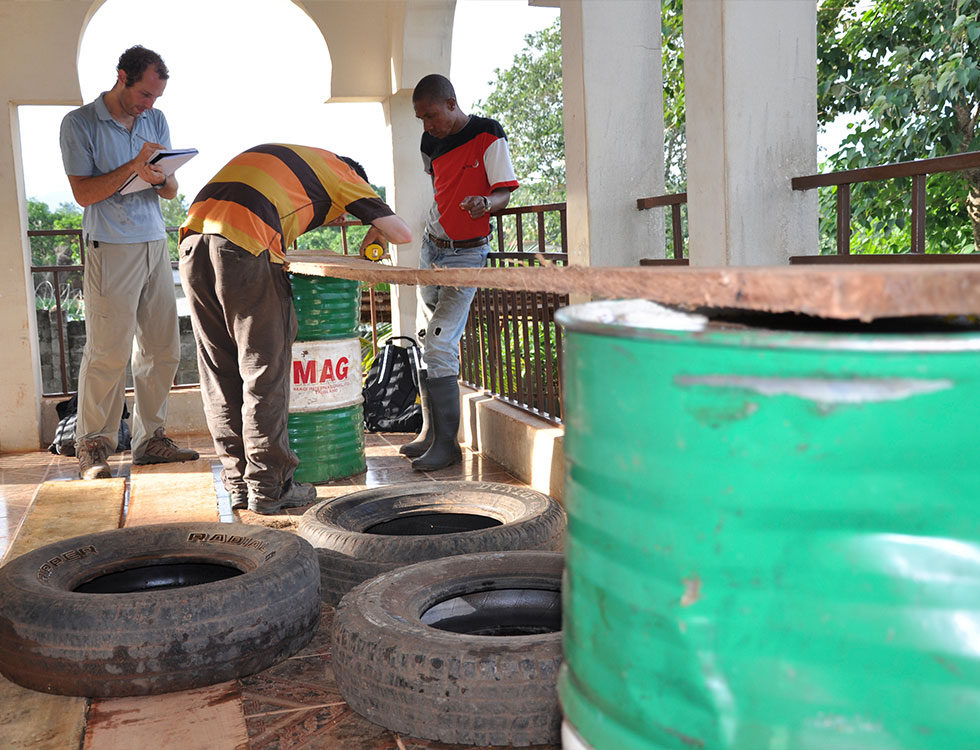
At that stage, Tim Marcot, then an Associate at Price & Myers and the main structural engineer for the project, travelled to Sierra Leone to visit the site and advise on the structural and construction strategy. Tim’s task was to turn the concept into workable reality. He needed to assess the available materials, tools, and skill base, and where necessary adapt the design in real time on site so that it could be assembled safely using hand tools and basic workshop facilities.
He worked alongside the Gola Forest team and knowledgeable local tradespeople, developing details that could be pre-fabricated in sections at the nearby Presidential Lodge workshop and then assembled on site. This approach meant that complex joints - such as the column-to-beam and bracing connections - could be accurately drilled and fitted at ground level before being raised into position. It also allowed for a system of repetitive, interchangeable components, reducing risk during construction and helping maintain consistent quality throughout.
Tim’s visit also informed decisions about foundation detailing, where we recommended shallow pad foundations projecting above ground to avoid excessive excavation, limit settlement, and keep the timber elements well clear of standing water. His direct engagement with the construction environment helped ensure that every element of the structural system - from the size of individual members to the sequencing of assembly - was achievable without the use of heavy machinery or imported expertise.

Engineering for durability and maintenance
Given the absence of local building codes, we worked with Article 25 to benchmark performance against UK standards where appropriate - for example, designing the timber structure to achieve the equivalent of a 60-minute fire resistance rating, and rationalising member sizes to control deflection and ensure lateral stiffness under wind load.
The design was also guided by a principle of maintenance through simplicity. All elements were dimensioned for easy replacement and repair. Timber members were designed to be lifted by hand, bolted rather than glued or nailed, and connected in such a way that they could be removed individually without dismantling the wider structure. The system was as much about long-term resilience as it was about initial buildability.
At a larger scale, the structural form played a role in the building’s environmental strategy. The wide roof overhangs were structurally expressed and extended to provide shade and rain protection while maintaining airflow. The raised deck provided naturally ventilated undercroft spaces that could be used for workshops and storage, and also helped reduce humidity levels within the building fabric.
A continuing partnership
The Gola Forest project remains one of the early examples of our work with Article 25, and a formative one. It set a template for us on collaboration between engineering and humanitarian architecture that has continued in many forms since. It was a project that demonstrated how thoughtful engineering - even at its most modest - can have a profound and lasting impact.
Looking back, what stands out is not only the technical ingenuity required to deliver a safe and practical building in such a remote context, but the shared ethos that underpinned the work. Article 25 have always approached architecture as a vehicle for dignity, education, and empowerment. Partnering with them challenged us to think differently about what constitutes “value” in design - not just efficiency or performance, but the legacy of skills and confidence left behind.
More than fifteen years later, we continue to work with Article 25, supporting projects that aim to improve lives through better buildings. The Gola Forest Programme reminds us why that partnership matters - a project that started in the rainforest but continues to influence how we design, collaborate, and build with care.