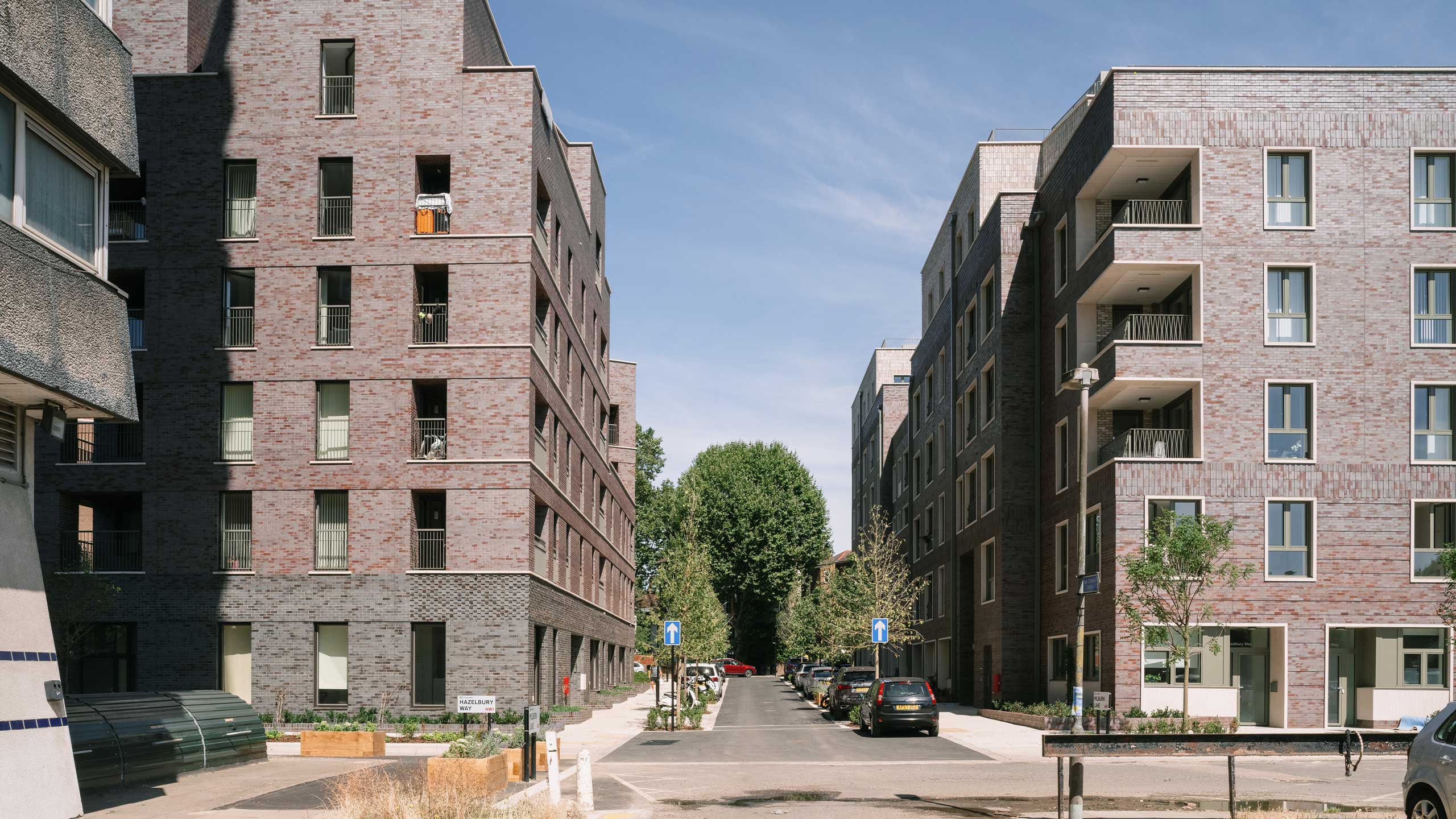
Agar Grove is the UK’s largest Passivhaus-certified estate regeneration project to date and the flagship scheme of Camden Council’s Community Investment Programme. Phase 1C is delivering 125 new homes—including apartments and maisonettes—alongside double-height commercial space at ground floor level, arranged around a new, leafy central avenue.
The two buildings that make up Phase 1C, Block I and Block JKL, are six-storey concrete frames designed to minimise embodied carbon by reducing the need for transfer structures.
Achieving Passivhaus accreditation demanded rigorous coordination across the design team, particularly around airtightness, insulation continuity, and junction detailing, which are critical elements in Passivhaus construction. Particular consideration was given to the detailing of interfaces, which can be challenging when working with multiple construction materials.
A key structural challenge in achieving Passivhaus standards was maintaining thermal breaks without compromising load paths. Bespoke thermal pads and stainless-steel bars were used to transfer loads at balconies and parapets while ensuring insulation performance was not affected. Under-slab heave protection was redesigned in collaboration with the contractor to avoid compromising the thermal line, with a build sequence that allowed insulation to be installed prior to reinforcement.


To accommodate thermal movements and optimise level changes across both buildings, a building movement joint was strategically placed at the party wall location between different block uses. This joint aligns with the change in storey height, maintaining terrace waterproofing and ensuring airtightness and thermal continuity through careful detailing.
Working with a sloping site, which falls 2 metres from north to south, presented its own challenges. The team designed stepped foundations and ground floor levels, along with external retaining elements throughout the landscaped courtyards and play areas.
Below ground, the design also had to respond to significant legacy constraints. The new buildings sit on the footprint of demolished low-rise blocks, requiring close coordination to avoid remnants of previous substructures. In addition, the team had to navigate a dense web of existing services, including electric, gas, drainage, CATV lines, and an exclusion zone for high-voltage cables crossing the site.
Cladding is supported off a thin-bed masonry inner leaf with a parge coat forming the airtight line, providing both thermal mass and durability. Structural detailing at balconies, roof upstands, and handrails avoids thermal bridging, with on-site testing used to validate fixing methods to the outer leaf.
This focus on sustainability ensured the buildings achieved high energy performance and minimal carbon footprints, aligning with Camden Council’s broader environmental goals.